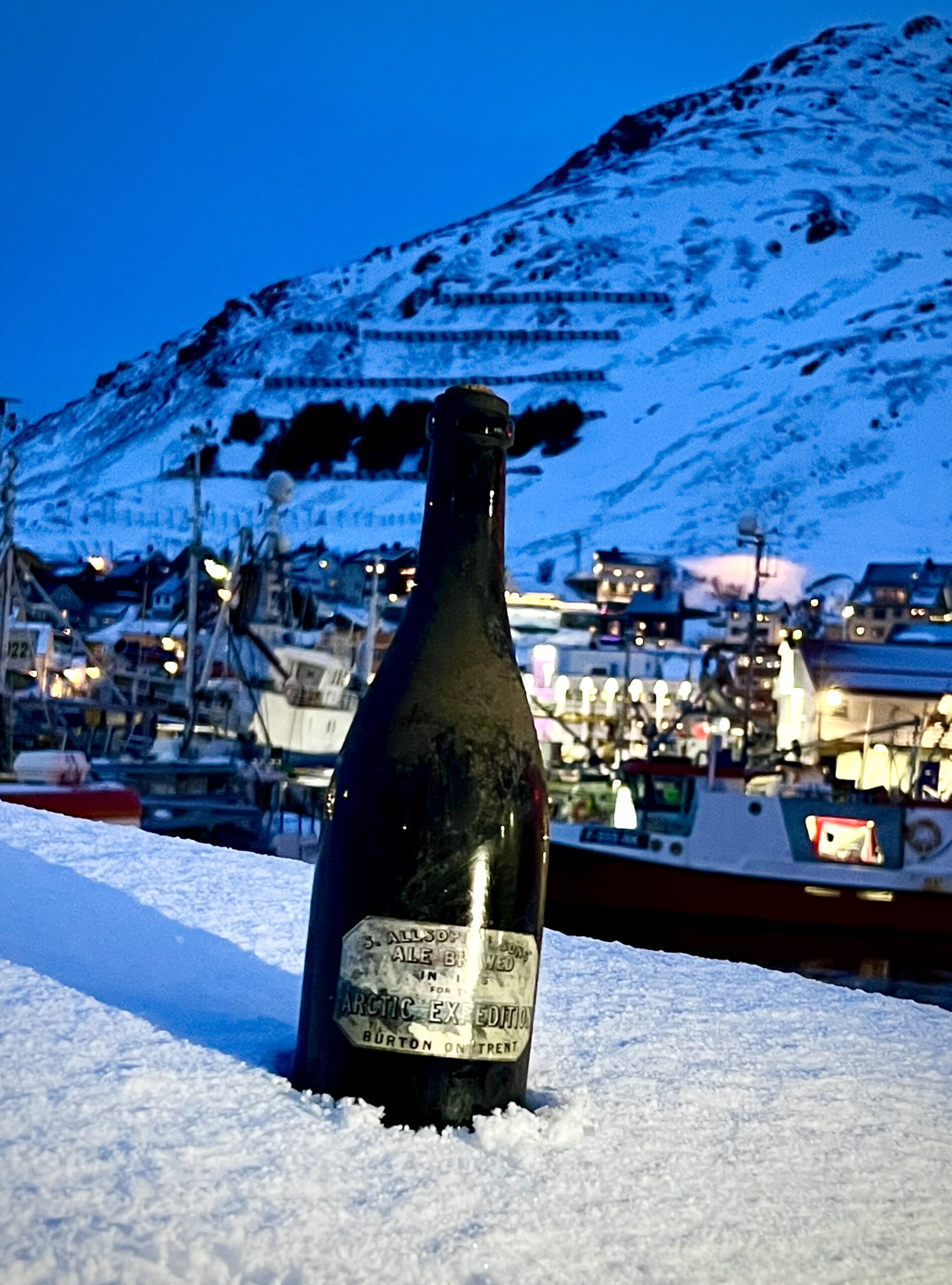
Take a bottle of beer on holiday and capture the moment. Easy, right?
Well, not when the bottle in question is 150 years old, covered in dust, and carrying the ghost of a failed polar expedition.
This isn’t just any bottle. It is Allsopp’s Arctic Ale, brewed in 1874 for Sir George Nares’ 1875 ill-fated attempt to reach the North Pole via Smith Sound on Greenland’s west coast. The men never made it, much like the bottle as this particular survivor surfaced in 2013, empty, forgotten in the cellar of Allsopp’s New Brewery in Burton.
The plan: take it north of the Arctic Circle and capture a suitably dramatic photograph; snow, cold, and if luck permits, the Northern Lights. The owner, Gary, had only one request: “I want it back with the dust intact.” Spoiler alert: he’ll be disappointed.
I’ve coined a new phrase for the occasion: you can’t take a 150-year-old bottle into Arctic Norway without disturbing the dust. Admittedly less catchy than the omelette one.
We arrive in Tromsø in late December 2024. Snow is falling, wind is howling, and the temperature hovers around eight below. Tromsø, the so-called “Arctic Capital,” sits like a jewel in the dark, polar night.

The idea is to ride the Fjellheisen cable car up to Storsteinen, a mountain ledge 421 metres above sea level, to capture a panorama of Tromsø glittering below. But the weather has other ideas. The cable car closes, too windy. Hiking through snowdrifts just isn’t an option.
The next day we try again. Ninety minutes in the queue, snow piling on our coats, and just as we reach the door, closed! The winds are back. So we try for shots at the mountain’s base: the bottle perched in untouched Nordic snow, Tromsø lights flickering behind. Atmospheric, yes, but not quite the grand vision.
The bottle now travels by sea, wrapped in bubble-wrapped like Fabergé Egg on MS Polarlys, part of the Hurtigruten fleet. We are ferried north through icy fjords. After a hearty dinner of Finnbiff stew (I have two portions because I can), we head outside as the ship docks at Skjervøy, a settlement clinging to bare rock, its name literally meaning “rocky island.” Docking is swift and precise: rope thrown, caught, secured, bays opened, passengers out, bays shut, rope cast off and dragged through the Kvænangen fjord. Fifteen minutes flat. Military in its efficiency.
The Northern Lights are a no-show, hidden behind stubborn cloud. I give up and retire to the cabin in search of sleep which proves as elusive as the lights. Our cabin sits above the engine, which roars into life at every port, shaking the walls until dawn. The Arctic doesn’t let travellers rest easily.

By late morning we reach Honningsvåg, latitude 70°58′43″ N just shy of Nordkapp, Europe’s northern tip. With only 2,600 residents, it still qualifies as a “city” in Norway. It huddles against a mountain, defended from avalanches by snow fences. The sun hasn’t risen here since late November and won’t return for weeks. The long Polar Night absolute.
Yet the city glows. Fishing boats fill the harbour, lights shimmer across snowdrifts, and the air feels both remote and alive. Here the bottle finally finds its moment. Netty, the photographer, lies flat in the snow while Holly assists, and the camera captures it: Allsopp’s Arctic Ale, dust and all, against the endless Arctic dark.

The 1875 expedition may have reached 83°20′26″ N, but this is where the bottle’s journey ends. For a moment, it feels right to bury it here in the frozen ground, a symbolic homecoming. But the snow is two feet deep, the earth solid, and, minor detail, I don’t have a shovel. Besides, Gary would probably kill me.
And so, the dust-covered relic returns with us, a little more travelled, a little less dusty, and with a story far richer than the one it carried in the brewery cellar.